




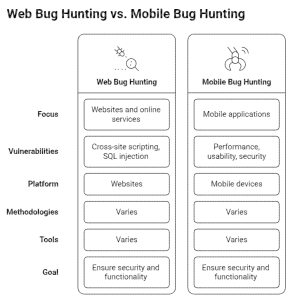
Bug hunting has also developed well beyond the days of simple injection vulnerabilities or improperly set up endpoints. The organizations grow on web and mobile platforms, and the attackers need to change their strategy, as well as the ethical hacker. Although web and mobile bug hunting have common roots, the weapons, tools and the attack surfaces of these two processes are becoming even more dissimilar in 2026.
These differences are vital to the security researchers and organizations in general understanding.
Shared Foundations, Different Battlefields
On the high level, web and mobile security testing are based on the basic principles: authentication, authorization, input validation, and data protection. Both platforms continue to have vulnerabilities in the form of insecure APIs, broken access control and business logic vulnerabilities.
But the difference between the ways in which these issues arise and the ways in which they are mapped to the abuse of power in web and mobile environments is great.
Web Bug Hunting: Depth, Logic, and Scale
Web applications are still highly complicated ecosystems of APIs, third-party integrations and cloud infrastructure. The current web bug hunting is emphasized on:
- API abuse and broken object-level authorization
- Business logic flaws in workflows and payments
- Authentication bypasses and session handling issues
- Misconfigured cloud services and exposed internal endpoints
Most of the powerful web vulnerabilities to be dealt with in 2026 are not scan and find. They need profound knowledge of application behaviour in exceptional situations. Effective web hunters are users, attackers and programmers all at the same time.
Mobile Bug Hunting: Visibility and Trust Issues
The mobile applications pose a new challenge of low visibility. Mobile clients tend to hide implementation in compiled code, bespoke SDKs, and encrypted communication unlike web applications.
Key mobile attack surfaces include:
- Insecure local storage and improper encryption
- Hardcoded secrets and API keys
- SSL pinning bypasses and traffic interception
- Weak client-side checks that trust the app too much
A major error that organizations commit is that they believe that mobile apps are safer due to the fact that they are difficult to inspect. As a matter of fact, mobile applications can easily be reverse-engineered and, through it, direct access to the backend systems is often disclosed.
APIs: The Common Weak Link
APIs are the major target whether web or mobile. Most mobile apps also use the same APIs as web platforms- but with less strong controls or assumptions of trusted clients.
This intersection will enable talented hunters to switch platforms, linking weaknesses across environments to more effect.
What Bug Bounty Platforms Look for in 2026
Contemporary bug bounty programs are not just based on vulnerability discovery. They assess:
- Ability to test across platforms holistically
- Understanding of platform-specific risks
- Responsible exploitation without harming users
- Clear demonstration of real business impact
The most effective researchers are not web only or mobile only any more. They know how systems relate- and fail in assumptions.
Call to Action
With the growth of attack surfaces, security testing should be changed as it can no longer be done in isolation. Bugv platforms allow organizations to test security in web and mobile environment by real world hacking.
When you need to learn how attackers can navigate between your mobile systems and web, Bugv can be used to test them as real attackers would, before they attack.