


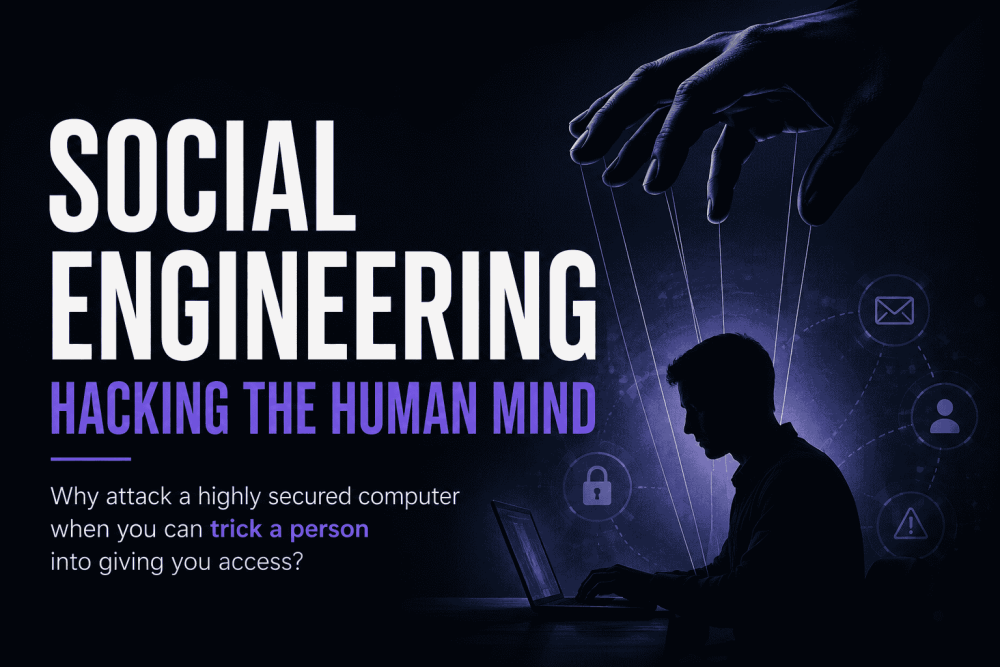

Why attack a highly secured computer when you can sometimes trick a person into giving you access?
For an ethical hacker, social engineering is studied with proper authorization so an organization can identify weaknesses in its employees security awareness and improve them.
What is Social Engineering?
Social engineering is the use of psychological manipulation and deception to influence someone into revealing information, granting access, or taking an action that they otherwise might not take.
It takes advantage of normal human behaviors such as:
- Trust
- Curiosity
- Fear
- Urgency
- Helpfulness
- Authority
- Desire to avoid problems
Simple example
Imagine someone receives a message:
“Your account has a security problem. Please verify your information immediately.”
The message creates fear + urgency.
The person may react quickly without checking whether the message is genuine.
That’s the basic principle behind many social-engineering attacks.
Why Is It Called “Hacking the Human Mind”?
Traditional hacking may target:
Computer → Software → Network → Database
Social engineering targets:
Human → Trust → Decision → Action
Computers can have firewalls, encryption and antivirus software, but humans can still make mistakes.
For example, an organization might have excellent technical security, but an employee could accidentally disclose confidential information to the wrong person.
So cybersecurity isn’t only about protecting technology.
It is also about protecting people from manipulation.
Social Engineering in Ethical Hacking
Ethical hackers may conduct authorized social-engineering assessments to determine whether employees can recognize suspicious situations.
For example, an organization might authorize a security team to conduct a controlled awareness exercise.
The organization could then measure:
- How many employees recognized the suspicious communication
- How many reported it
- What security-awareness gaps existed
- Whether employees followed company procedures
The purpose is education and security improvement, not embarrassing employees.
The Psychology Behind Social Engineering
Social engineering often exploits predictable human behaviors.
1. Trust
People tend to trust familiar names, organizations, or people in positions of authority.
2. Urgency
Messages saying “act immediately” can cause people to make decisions without checking.
3. Fear
A person may become more likely to respond when they believe something bad will happen.
4. Curiosity
People naturally want to know what’s behind something interesting or unexpected.
5. Helpfulness
People often want to help colleagues, customers, or people who appear to need assistance.
6. Authority
Someone claiming to be a manager, administrator, official, or other authority figure may receive more cooperation.
Why It Matters?
Social engineering shows that cybersecurity is not only a technology problem—it is also a human problem.
An organization can invest heavily in firewalls, encryption, monitoring, and other security technologies, but people still need to recognize manipulation and follow secure procedures.
Ethical hackers help organizations understand these risks through authorized and controlled security assessments.
The key message:
“The strongest cybersecurity system is not just one that protects computers; it also prepares people to make secure decisions.”