




Imagine losing billions of dollars in cryptocurrency within just 20 minutes.
That is what happened to Binance, the world’s largest cryptocurrency exchange, following a major cybersecurity breach on October 29, 2026. Attackers stole approximately $6.3 billion worth of digital assets, making the incident one of the most significant cryptocurrency thefts ever recorded.
But this wasn’t simply a case of hackers stealing passwords or exploiting a vulnerable application. The incident exposed something much more concerning: how attackers can compromise the internal systems responsible for authorizing and processing financial transactions.
The breach has raised serious questions about cryptocurrency security, privileged access management and the protection of critical business infrastructure.
So, what happened, how did the attackers gain access and what can businesses learn from this incident?
Let’s break it down.
What Happened to Binance?
On October 29, Binance identified a major security incident involving its transaction-processing infrastructure.
According to preliminary findings, attackers gained access through a compromised laptop belonging to a DevOps engineer. This access reportedly allowed them to enter a service container and submit unauthorized withdrawal transactions through Binance’s internal systems.
The attackers then drained approximately $6.3 billion in cryptocurrency from wallets used to process transactions across multiple blockchain networks.
One of the most alarming aspects was the speed of the operation. Blockchain investigators reported that most of the stolen funds were transferred within approximately 20 minutes.
Binance initially suspended deposits and withdrawals while investigating the incident and coordinating with blockchain security companies, law enforcement agencies and cryptocurrency issuers.
The company subsequently stated that it would cover the financial impact rather than pass the losses on to customers.
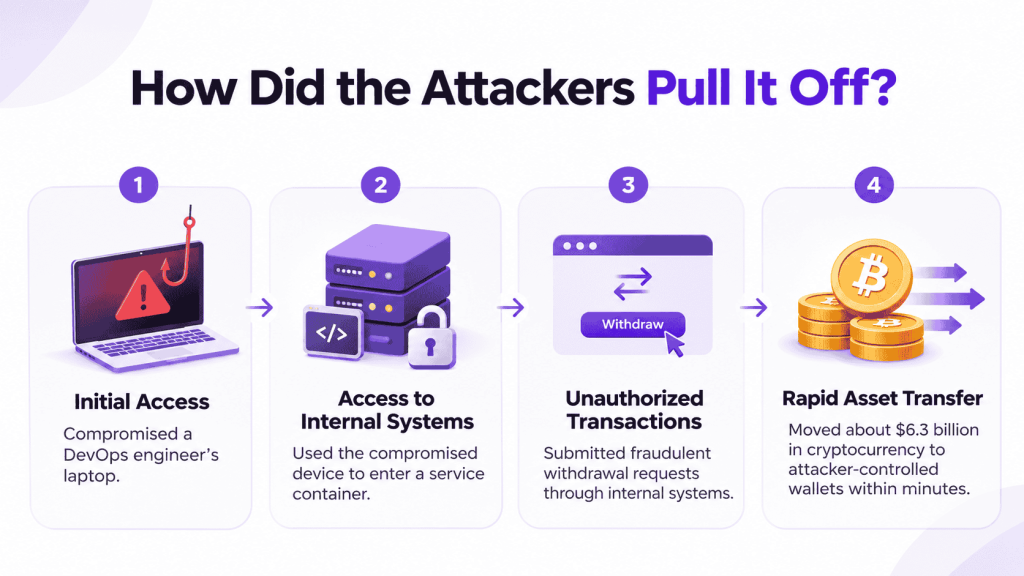
How Did the Attackers Pull It Off?
Although the full technical investigation is still developing, available findings point towards a compromise of internal infrastructure and transaction authorization processes.
Here is what is currently understood:
1. Initial Access Through an Employee’s Device
The attackers reportedly compromised a DevOps engineer’s laptop, creating an entry point into Binance’s internal environment.
An employee’s workstation can become a significant security risk when it has access to sensitive development or operational systems.
2. Access to Internal Infrastructure
The compromised device reportedly enabled access to a service container within Binance’s environment.
This suggests that the attackers were able to move beyond the initial compromised device and interact with systems involved in transaction processing.
3. Unauthorized Transaction Requests
Rather than simply stealing cryptocurrency wallet passwords, attackers manipulated the systems responsible for submitting withdrawal transactions.
This is particularly concerning because transaction authorization infrastructure is one of the most sensitive components of any cryptocurrency exchange.
4. Rapid Movement of Stolen Assets
Once unauthorized transactions were initiated, billions of dollars in digital assets were transferred to attacker-controlled wallets.
The operation involved multiple blockchain networks, making the investigation and recovery process significantly more complicated.
Importantly, Binance stated that it had found no evidence of a wallet private key leak in its initial investigation. The incident highlights how compromising the systems surrounding a secure asset can be just as damaging as compromising the asset itself.
Who Was Behind the Attack?
The FBI attributed the Binance theft to North Korea’s TraderTraitor group, a cyber threat actor associated with major cryptocurrency theft operations.
Blockchain intelligence companies had also identified similarities between this incident and previous attacks linked to North Korean threat actors.
Such operations are often associated with highly organized cybercriminal activities involving sophisticated infrastructure, coordinated execution and complex money-laundering techniques.
The attribution highlights a growing concern for the cryptocurrency industry: cyberattacks are no longer limited to independent hackers looking for financial opportunities. State-sponsored threat actors can target financial infrastructure on an enormous scale.
What Happened to the Stolen $6.3 Billion?
Recovering stolen cryptocurrency is extremely challenging, particularly when attackers move assets across multiple blockchain networks.
However, the incident also demonstrated the importance of collaboration across the cybersecurity and financial technology industries.
Several cryptocurrency companies and stablecoin issuers, including Tether and Circle, worked with investigators to identify and freeze affected assets.
According to blockchain intelligence firm Elliptic, approximately $2.85 billion had been frozen or seized by November 1.
Binance also announced that it had arranged resources to cover the affected assets. On November 2, Reuters reported that the exchange had replaced approximately $6 billion of the stolen funds, with the remaining portion involving less-liquid tokens.
Withdrawals have since resumed in phases following the security response.
Although these developments represent significant recovery efforts, the incident demonstrates how difficult it can be to contain a cyberattack once unauthorized transactions begin.
5 Major Cybersecurity Lessons Businesses Should Learn
The Binance incident is not just a cryptocurrency industry problem. Its underlying security lessons apply to banks, fintech companies, SaaS providers, enterprises and organizations handling sensitive information.
1. Employee Devices Are Part of Your Security Perimeter
A compromised employee laptop can become an entry point into an organization’s most critical systems.
Businesses must implement endpoint detection and response (EDR), device monitoring, regular security updates and strict access policies.
An employee device should never automatically be trusted simply because it belongs to an authorized team member.
2. Privileged Access Must Be Closely Controlled
Not every employee needs access to every internal system.
Organizations should implement Role-Based Access Control (RBAC), Privileged Access Management (PAM) and Multi-Factor Authentication (MFA).
Access should be limited to what employees actually need to perform their responsibilities.
3. Transaction Authorization Needs Multiple Security Layers
Critical financial operations should never depend on a single authorization mechanism.
Businesses handling financial transactions should consider:
- Multi-party transaction approval.
- Withdrawal limits and velocity controls.
- Real-time anomaly detection.
- Independent verification of sensitive operations.
- Automated alerts for unusual transaction activity.
These controls can help prevent a compromised account or internal service from becoming a single point of failure.
4. Continuous Security Testing Is Essential
Security vulnerabilities are not always visible during routine development or internal reviews.
Regular Vulnerability Assessment and Penetration Testing (VAPT), infrastructure security reviews and controlled security testing can help identify weaknesses before attackers exploit them.
Organizations should also consider continuous security assessments as their infrastructure, applications and attack surfaces evolve.
5. Monitor Your Entire Attack Surface
Organizations often focus on protecting their primary applications while overlooking exposed subdomains, forgotten assets, third-party integrations and misconfigured infrastructure.
Continuous attack surface monitoring helps identify potential exposure points before they become entry points for attackers.
Security is not a one-time activity. It requires ongoing monitoring, testing and improvement.
How Can Organizations Strengthen Their Cybersecurity?
The Binance incident reinforces an important principle: having security tools in place does not automatically mean an organization is secure.
Businesses need a proactive security strategy that combines prevention, detection and continuous assessment.
Some essential measures include:
- Conduct regular penetration testing to identify exploitable weaknesses.
- Implement vulnerability disclosure programs to receive security reports responsibly.
- Establish bug bounty programs to encourage independent security researchers to identify vulnerabilities.
- Monitor exposed assets, domains and infrastructure continuously.
- Review employee access privileges and internal security configurations.
- Develop an incident response plan and regularly test its effectiveness.
Organizations that proactively identify weaknesses are better positioned to reduce their exposure to cyber threats.
Final Thoughts
The $6.3 billion Binance breach is a reminder that even the world’s largest technology and financial platforms are not immune to cybersecurity failures.
The incident also challenges a common assumption about digital security: protecting passwords, encryption keys and applications is not enough.
Attackers may target the people, devices, internal services and authorization workflows surrounding critical systems.
For businesses, the lesson is straightforward: cybersecurity must extend beyond the application layer. Every device, account, integration and internal process connected to critical infrastructure deserves attention.
The question is no longer whether your organization has security measures in place. It is whether those measures can withstand a real-world attack.
At Bugv, we believe proactive security testing and responsible vulnerability research are essential to building a safer digital ecosystem.
Through Bug Bounty Programs, Vulnerability Disclosure Programs (VDPs) and Penetration Testing services, Bugv helps organizations identify security weaknesses and strengthen their digital infrastructure before attackers find them.
Don’t wait for a breach to discover your vulnerabilities. Secure your systems with Bugv.
Visit bugv.io to explore our cybersecurity services.