



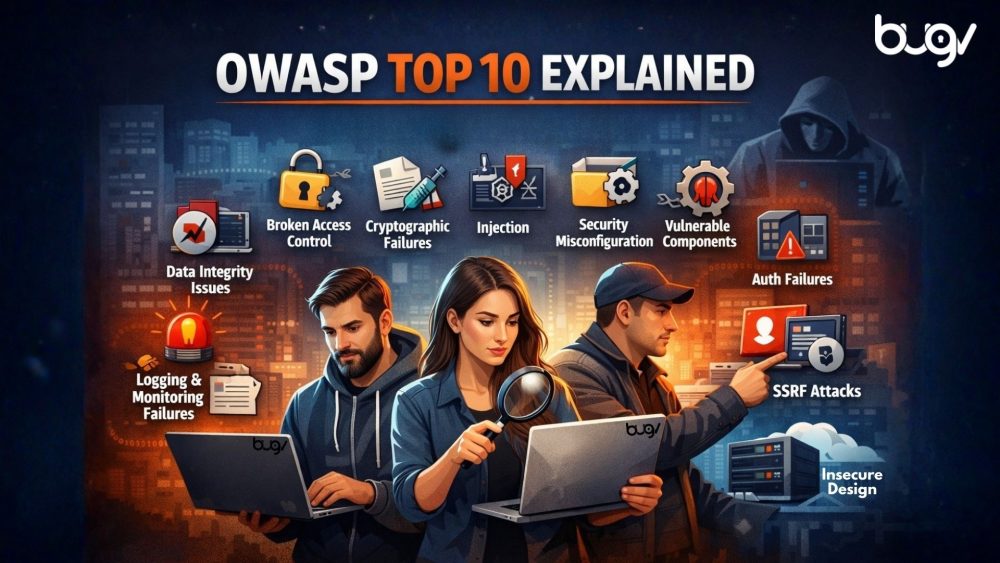

The most commonly used list of security risks that are considered critical to web applications is the OWASP Top 10. The Open Worldwide Application Security Project updates it periodically according to the data provided by actual vulnerabilities. To anyone venturing in the bug bounty hunting, it is mandatory rather than optional to learn the OWASP top 10 as the starting point.
Below is a description of each of these categories in simple terms, and the type of practical examples that are common in bug bounty programs.
1. Broken Access Control
This is the most prevalent weakness of the contemporary web applications. It happens when users can gain access to resources or make actions of which they are not supposed to be.
The general cases: an average user will enter a different ID in a URL of their account number and access the private information of another person. No special ability needed – simply replacing a number. This type of bug is always rated between medium and critical basing on the type of data revealed.
2. Cryptographic Failures
This, which was formerly known as Sensitive Data Exposure, includes the cases when sensitive data is not exposed sufficiently. This comprises passwords that are not in hashed format, information sent through HTTP (rather than HTTPS) or weak encryption algorithms that are still in operation.
This may be manifested in bug bounty programs in the form of API responses containing plaintext tokens, or bugs storing sensitive user data in local storage non-encrypted.
3. Injection
The most famous one is SQL Injection, though command injection, LDAP injection, and many others belong to this category. Injection flaws as discussed in our earlier post are also actively used in 2026 even though they have been well understood.
Any injection point can be any point of user input on a query, command, or interpreter that has not been sanitized appropriately.
4. Insecure Design
This is more recently added to the list of OWASP and is used to refer to design weaknesses inherent to an application – not just bugs in the implementation. The design of an application permitting unlimited attempts to reset passwords without a rate limit is insecure though the code may be well written.
These are bugs that are more difficult to locate and in many cases high impact since they cannot be resolved by a mere patch.
5. Security Misconfiguration
The bug bounty programs are one of the most commonly rewarded classes of bugs. This consists of default credentials that are not cleared, unneeded services that are open, error messages that are verbose and include stack traces as well as cloud storage buckets that are publicly accessible.
Misconfigurations of S3 buckets have already caused some of the most significant data breaches in the recent years. Misconfigured cloud infrastructure is a fairly frequent occurrence in the evolving startup tourism in Nepal.
6. Weak and Out-of-date Components.
Instances of use of libraries, frameworks or dependencies that have established vulnerabilities will fall under this category. One old package has the power to bring a critical vulnerability in an otherwise well-written application.
In bug bounties, it may manifest itself as an application using an outdated version of a JavaScript library or a CMS plug-in with an published CVE that has not been fixed.
7. Authentication Failures and Identification Failures.
This includes vulnerabilities related to the application in terms of identity control weak password policies, the absence of multi-factor authentication, the use of vulnerable session tokens, or the display of session IDs in the URLs.
Another similarity: The applications that do not revoke the session tokens upon logout, i.e., so that a stolen token is still valid forever.
8. Software and Data Integrity Failures.
This type encompasses those scenarios where there is the use of code or data without the adequate integrity checking. An example of a famous real-life situation is a supply chain attack, in which malicious code is sent across a trusted software pipeline.
In the case of bug bounties, this may manifest as applications loading JavaScript sources not subject to subresource integrity, and hence, prone to script injection in case that source is compromised.
9. Logging and Monitoring Failures in security.
Although this cannot be exploited straight forward by a bug bounty hunter, in the true sense of the word, the lack of logging would allow the breaches to go undetected longer. Certain programs do reward the discovery of missing audit trails of sensitive actions particularly.
When there is an application that lets hundreds of unsuccessful login attempts go by without any notification or lockout, it is actually a design and a failure in logging.
10. Server-Side Request Forgery (SSRF).
Introduction SS Rafs is a situation in which an attacker is in a position to have the server make requests on their behalf, usually to internal services that are not open to the wider world. This may result in exposure of cloud metadata, internal APIs or even additional network compromise.
The issue of SSRF has gained relevance in recent times with the rising number of applications being operated in cloud infrastructure. An effective SSRF attack against an application that runs on the cloud can reveal AWS or GCP metadata endpoints, which may expose the credentials of the entire infrastructure.
How to Use This List
The OWASP Top 10 is not a checklist that you go through the once. It is a thinking model on the location of vulnerabilities that could be present. These ten groups ought to guide your preliminary reconnaissance and testing strategy when you are targeting a new bug in a bug bounty program.
Each of them is a category of actual bugs that actual developers add to actual applications – and the ones you will be testing.
The OWASP Top 10 isn’t just theory, it’s the blueprint of real vulnerabilities actively exploited in bug bounty programs worldwide, including right here in Nepal’s growing tech ecosystem. Master these categories to transform from novice hunter to elite finder of critical flaws that organizations pay top dollar to fix. Ready to put this knowledge into action? Join Bugv’s bug bounty programs and expert vulnerability assessments to discover, report, and get rewarded for the security weaknesses that matter most.