



Artificial intelligence is changing the way businesses work. Teams are using AI to automate tasks, analyze information and build products faster.
But businesses are not the only ones using it.
Cybercriminals are also using AI to make attacks faster, more convincing and easier to scale.
The question for businesses is no longer simply “Can we be attacked?” It is “Are we prepared to respond when attackers move faster than ever?”
AI Is Changing the Cyber Threat Landscape
Cyberattacks have always evolved alongside technology. What has changed with AI is the speed and scale at which attackers can operate.
Tasks that previously required significant time and technical effort can increasingly be automated or accelerated with AI.
Attackers can use AI to research potential targets, generate convincing messages, analyze information and assist with finding weaknesses in digital systems.
This does not necessarily mean AI has created completely new types of cyberattacks. Instead, it is making many existing techniques more efficient.
How Are Attackers Using AI?
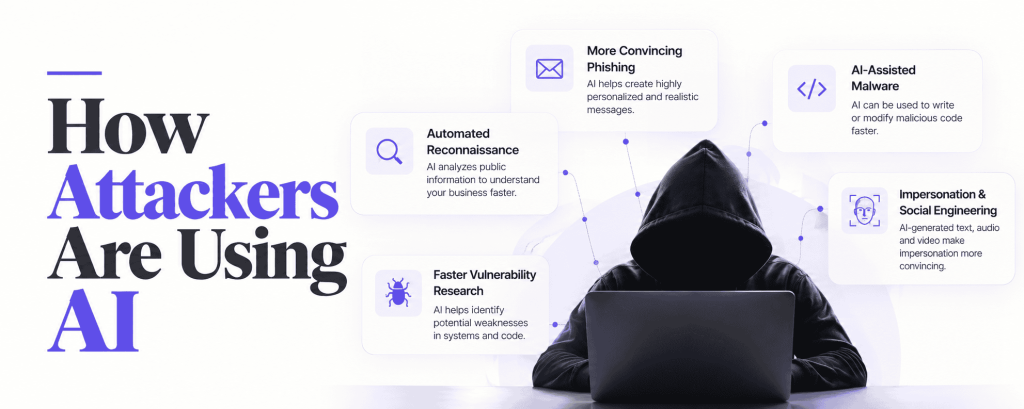
AI can support different stages of an attack, from reconnaissance to social engineering.
1. Automated Reconnaissance
Before attacking a business, attackers need to understand their target.
AI can help analyze publicly available information about a company, its employees, technologies, domains and digital presence much faster.
The more information an attacker can gather, the more targeted an attack can become.
2. More Convincing Phishing
Traditional phishing emails are often easy to identify because of poor grammar, unusual wording or obvious mistakes.
AI can help attackers create messages that are more personalized and convincing.
An attacker may generate content that closely resembles legitimate business communication, making it harder for employees to recognize the threat.
3. Faster Vulnerability Research
Finding vulnerabilities requires understanding how systems work and where weaknesses may exist.
AI can assist attackers and researchers in analyzing code, identifying potential weaknesses and accelerating parts of the vulnerability discovery process.
For businesses, this means vulnerabilities may be discovered and investigated faster than before.
4. AI-Assisted Malware
AI can also assist attackers in writing or modifying malicious code.
While AI does not magically turn someone into an expert hacker, it can reduce the amount of time and effort required for certain technical tasks.
This lowers the barrier for some attackers and allows more people to experiment with sophisticated techniques.
5. Impersonation and Social Engineering
AI-generated text, images, audio and video are making impersonation increasingly convincing.
Attackers can potentially use publicly available information to create highly targeted social engineering campaigns against employees, customers or business partners.
Why Businesses Are More Exposed
Modern businesses depend on a growing number of digital systems.
Websites, mobile applications, APIs, cloud infrastructure, employee accounts, third-party services and internal systems all contribute to an organization’s attack surface.
A vulnerability in just one exposed system can become an entry point for a larger attack.
The challenge becomes even greater when businesses do not have complete visibility into everything connected to their digital environment.
The Biggest Problem Is Speed
One of the biggest changes AI brings to cybersecurity is speed.
A vulnerability that remains unnoticed for weeks or months gives attackers more time to discover and exploit it.
At the same time, businesses may still rely on periodic security assessments rather than continuously looking for weaknesses.
This creates a gap.
Attackers do not necessarily wait for your next security assessment.
That is why organizations need security processes that continuously identify, report and address vulnerabilities.
Are Businesses Actually Ready?
Many organizations invest in firewalls, antivirus software, endpoint protection and other security technologies.
These tools are important, but technology alone does not guarantee security.
Businesses should also ask:
- Do we know all of our internet-facing assets?
- When was our last security assessment?
- How quickly can we identify and fix a critical vulnerability?
- Do security researchers have a safe way to report vulnerabilities to us?
- Are we continuously testing our applications and infrastructure?
- Are our employees prepared for increasingly convincing social engineering attacks?
- What happens if someone discovers a vulnerability in our system today?
If the answer to several of these questions is unclear, there may be gaps worth addressing.
What Can Businesses Do?
Preparing for AI-powered threats does not require completely rebuilding your security strategy.
Businesses can start by strengthening the fundamentals.
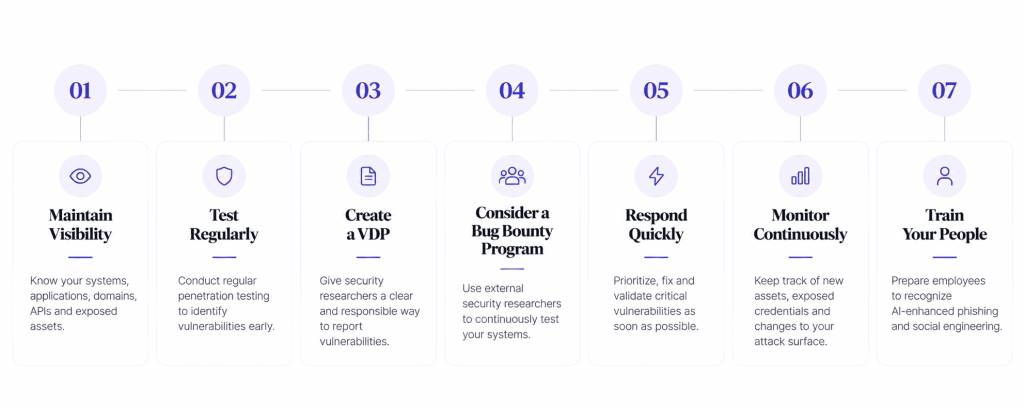
Maintain Visibility
Know what systems, applications, domains, APIs and services belong to your organization and understand what is exposed to the internet.
Test Regularly
Security testing should not happen only after a major incident.
Regular penetration testing can help identify vulnerabilities before attackers discover them.
Create a Vulnerability Disclosure Program
A Vulnerability Disclosure Program (VDP) gives security researchers a clear and responsible way to report vulnerabilities they discover in your systems.
Instead of leaving researchers unsure about how to contact your organization, a VDP establishes a defined reporting process.
Consider a Bug Bounty Program
For organizations looking for continuous external security testing, a Bug Bounty Program can bring security researchers from around the world into the process.
Researchers can identify vulnerabilities that internal teams or traditional assessments may not discover.
Respond Quickly
Finding a vulnerability is only the beginning.
Organizations need a clear process for triaging, prioritizing, fixing and validating vulnerabilities.
The faster a critical vulnerability moves from discovery to remediation, the smaller the window of opportunity for attackers.
Security Needs to Move at the Same Speed
AI is not automatically going to make every cyberattack more sophisticated.
But it can make certain parts of an attack process faster, cheaper and easier to scale.
That changes the security equation for businesses.
Organizations cannot rely solely on security tools or occasional assessments. They need a combination of visibility, testing, responsible disclosure and continuous improvement.
At Bugv, businesses can use Pentesting, Vulnerability Disclosure Programs and Bug Bounty Programs to identify security weaknesses and create a structured process for addressing them.
Because the goal of cybersecurity is not to wait until an attacker finds the vulnerability.
It is to find it first.
Is Your Business Ready?
Your systems may be secure today. But security is not a one-time achievement.
As your technology changes, your attack surface changes with it.
Find vulnerabilities before attackers do.
Explore Bugv’s cybersecurity solutions and build a stronger approach to vulnerability discovery and responsible disclosure.