





You have just discovered a critical vulnerability in a live web application. Thousands of users’ data could be at risk. The clock is ticking. What do you do next? The answer to that question defines not just your reputation as a security researcher, but potentially your legal standing and the safety of real people. The debate between responsible disclosure and full disclosure is one of the most consequential and most misunderstood conversations in the cybersecurity community.
Both approaches have legitimate arguments behind them. Understanding the difference, the risks, and the ethics of each is essential knowledge for every researcher, whether you are a seasoned professional or just starting your bug bounty journey on a platform like Bugv.
What Is Responsible Disclosure?
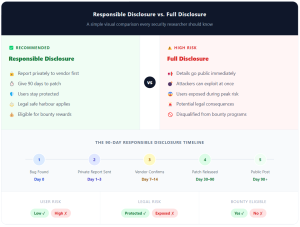
Responsible disclosure also called coordinated disclosure is the practice of privately reporting a vulnerability to the affected organisation before making any information public. The researcher notifies the vendor, allows a reasonable period for the vulnerability to be patched (typically 90 days, following Google Project Zero’s widely adopted standard), and only publishes details after a fix has been deployed or the deadline has passed without response.
The philosophy is straightforward: the goal of security research is to improve security, not to cause harm. Publishing a vulnerability before a patch exists hands a ready-made weapon to every malicious actor who reads the disclosure. Responsible disclosure prioritises the safety of end users above the researcher’s desire for immediate recognition.
What Is Full Disclosure?
Full disclosure takes the opposite stance. Proponents argue that vendors, left to their own devices, will quietly ignore vulnerability reports or delay patches indefinitely particularly when fixes are costly or disruptive. By making vulnerability details public immediately, full disclosure creates market pressure and public accountability that forces vendors to act.
The full disclosure movement has historical merit there are well-documented cases of vendors sitting on critical bug reports for years, only acting when forced by public exposure. However, the same publication that pressures a vendor also arms attackers, and the window between disclosure and patching is precisely when users are most at risk.
The Middle Ground: Bug Bounty Programs
Bug bounty programs, such as those managed through Bugv, represent the most structured and equitable expression of responsible disclosure. They establish clear rules of engagement defined scope, response timelines, reward structures, and mutual expectations that protect both the researcher and the organisation. Researchers receive fair compensation. Organisations receive private, actionable reports with time to remediate. Users are protected. Everyone benefits.
For researchers operating in South Asia, structured platforms like Bugv also provide crucial legal clarity. Informal vulnerability reports even well-intentioned ones can expose researchers to legal risk in jurisdictions where computer access laws are broad and ambiguous. A formal bug bounty program with documented safe harbour provisions removes that uncertainty entirely.
Responsible Disclosure vs. Full Disclosure
Which Approach Should You Follow?
For the vast majority of researchers particularly those working through structured bug bounty programs responsible disclosure is the only defensible choice, both ethically and legally. The exceptions are narrow: if a vendor is demonstrably unresponsive after repeated contact, if the vulnerability is already being actively exploited, or if public safety is at imminent risk, some security professionals argue that public disclosure becomes justified. Even then, most reputable researchers exhaust every private channel first.
The security community’s credibility as a force for good depends on the discipline of its members. When researchers act responsibly, vendors are more willing to engage, governments are more willing to protect them, and organisations are more willing to invest in the programs that compensate them.
Bugv is built on the principle of responsible, structured security research. Whether you are a researcher looking for a legitimate platform to report findings and earn rewards, or a business seeking a clear managed process for receiving vulnerability disclosures. Bugv provides the framework, the protection, and the community to make it work. Responsible disclosure starts with the right platform.