





Every year, thousands of web applications are compromised through a handful of well-documented, well-understood vulnerabilities. The frustrating truth is that many of these breaches are entirely preventable. Three vulnerability classes: Insecure Direct Object Reference (IDOR), Cross-Site Scripting (XSS), and Server-Side Request Forgery (SSRF) consistently appear at the top of bug bounty reports and security audits worldwide, including those submitted through Bugv.
Understanding these vulnerabilities is not just the responsibility of security researchers. Developers, product managers, and business owners all benefit from knowing what these threats are, how they work, and why they are so frequently exploited. This article breaks down each one in plain language.
IDOR: When Access Control Fails Silently
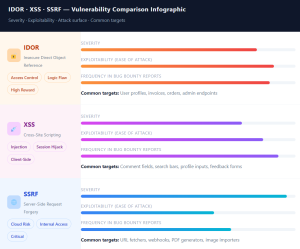
Insecure Direct Object Reference occurs when an application exposes internal implementation objects such as database record IDs, file names, or account numbers directly in a URL or request parameter, without verifying whether the requesting user actually has permission to access that object. An attacker simply changes the ID in a URL from /invoice?id=1042 to /invoice?id=1043 and suddenly views another user’s private invoice. No hacking tool required just a browser and curiosity.
IDOR vulnerabilities are alarmingly common because they stem from a logic error rather than a technical flaw. Developers assume users will only access their own data. Attackers do not share that assumption. On Bugv, IDOR remains one of the most frequently reported and rewarded vulnerability classes, particularly in fintech and e-commerce platforms where sensitive records are abundant.
XSS: Injecting Code Into Trusted Pages
Cross-Site Scripting allows an attacker to inject malicious scripts into web pages that are then executed in the browser of an unsuspecting user. When a website fails to sanitise user input a comment field, a search bar, a profile name an attacker can embed JavaScript that steals session cookies, redirects users to phishing pages, or silently captures keystrokes. The victim’s browser trusts the page it is on, and so it executes the injected code without question.
XSS attacks range from mildly annoying to catastrophically damaging. Stored XSS, where the malicious script is saved to a database and served to every visitor can affect thousands of users from a single submission. It is a reminder that any data entered by a user must be treated as untrusted until proven otherwise.
SSRF: Weaponising the Server Itself
Server-Side Request Forgery is among the more sophisticated vulnerabilities on this list, and its impact has grown substantially as cloud infrastructure has become the norm. In an SSRF attack, the attacker tricks the server into making HTTP requests on their behalf to internal services, cloud metadata endpoints, or other networked resources that should never be publicly accessible.
A common scenario: an application allows users to submit a URL for image fetching. The attacker submits the internal cloud metadata URL (http://169.254.169.254/latest/meta-data/) instead of an image URL, and the server helpfully retrieves it and returns sensitive credentials. SSRF vulnerabilities have been behind several high-profile breaches in recent years and carry critical severity ratings when cloud environments are involved.
What Can You Do About These Vulnerabilities?
For developers, the fix for all three starts with the same principle: never trust user-supplied input or identifiers. Implement proper authorisation checks on every request (IDOR), encode all output and use Content Security Policy headers (XSS), and restrict outbound server requests to a strict allowlist (SSRF). For organisations without the resources to audit every endpoint manually, a crowdsourced security program through Bugv provides continuous, expert-driven coverage at a fraction of the cost of traditional testing.
For security researchers, these three vulnerability classes represent some of the most accessible and consistently rewarded entry points in bug bounty programs. Understanding them deeply not just the mechanics, but the business impact is what separates a good report from an exceptional one.
Vulnerabilities like IDOR, XSS, and SSRF are not theoretical risks, they are being actively exploited in platforms just like yours, right now. Bugv connects your business with a vetted community of security researchers who find these issues before attackers do. Whether you are looking to launch a bug bounty program or start with a Vulnerability Disclosure Program, Bugv makes it simple, structured, and effective. Start securing your platform with Bugv today.